
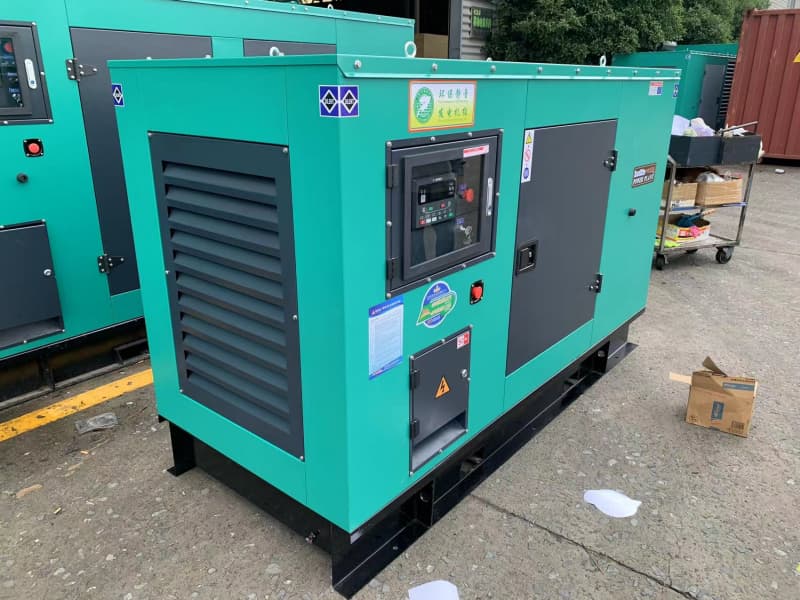
A 200kW silent diesel generator is often bought for offices, clinics, small factories and commercial buildings. The engine and alternator are only half the decision. The other half is site preparation. If the concrete pad, airflow, exhaust route or ATS wiring are wrong, even a good set will overheat, smoke, trip or fail warranty performance tests.
This checklist is written for buyers who need a practical installation guide, not a sales brochure. It follows the same items our Yangzhou factory asks customers to confirm before an export set is loaded.
1. Choose the location before choosing the enclosure
Do not place a silent set where staff are forced to listen to it for years. Even a canopy-rated 70–75 dB(A) unit is loud at close range. Keep the intake and discharge side away from windows, air conditioners, rest areas and boundary walls.
Outdoor installation is common for silent canopy sets, but the site still needs drainage. Rainwater should flow away from the base, not toward the control panel. If the set is placed in a basement or sound-attenuated room, the enclosure is not enough: ducting must be added for intake and outlet air.
2. Prepare a level concrete base
The base must support the full weight of the set, fuel tank and canopy. A 200kW unit is not a small appliance. It needs a level concrete pad, anti-vibration mounts and enough edge around the frame for maintenance.
A common mistake is mounting the generator directly on loose bricks or an uneven steel frame. Under running vibration, piping and cable connections can loosen. Factory sets are tested with the engine running at load; the site base should be rigid enough to protect that alignment.
3. Size the fuel tank for the real duty
Standby buyers usually want at least 8–12 hours of autonomy. Prime-power buyers may need 24-hour tanks or external bunded tanks. Do not rely on the built-in canopy tank if the site has long outages.
Fuel quality matters in export projects. Use clean diesel, water separator maintenance access and a fuel vent away from heat. If the project is in a cold climate, confirm whether a coolant heater, sump heater or battery heater is required.
4. Plan exhaust and airflow early
A silent generator still needs combustion air and cooling air. Block the air path and the set will derate or shut down. Plan exhaust pipe routing, flexible bellows, heat shielding and rain caps before the canopy is delivered.
For indoor plant rooms, exhaust back-pressure must stay within engine limits. For outdoor canopy units, keep exhaust discharge away from air intakes and nearby windows. Black smoke at start is normal briefly; continuous smoke means the load or fuel setup needs checking.
5. Connect ATS and switchgear correctly
A backup generator is useful only if it transfers automatically. The ATS should disconnect the mains, start the set, warm up briefly, transfer load, then return when mains stability returns. Test the transfer logic before relying on it.
Tell the supplier whether the site needs:
- Automatic transfer switch
- Mains and generator breaker interlock
- Remote monitoring via 4G modem
- Emergency stop at the building entrance
- Paralleling for future expansion
6. Confirm electrical protection and voltage
Export projects often mix 50Hz and 60Hz expectations, 400V three-phase and 230V single-phase needs, and different socket standards. The generator nameplate is not enough. Confirm voltage, frequency, phase, neutral arrangement and short-circuit withstand level with the electrical consultant.
If the site has sensitive loads such as servers, medical equipment or PLC controls, ask about voltage regulation, transient response and battery-backed control power.
7. Noise is measured, not guessed
A silent canopy reduces noise, but it does not remove it. Ask for the noise target at 7 meters, and keep the set as far as practical from neighbours. If the site is near a hospital, school or residential area, an acoustic enclosure or container may be safer than a standard canopy.
Factory load test matters
Before shipment, our Yangzhou factory runs the set under load and checks oil pressure, water temperature, voltage, frequency and protection trips. Ask for the test report, not only a nameplate photo. That report tells you whether the set actually carried the rated load.
Final checklist before delivery
| Item | What to confirm |
|---|---|
| Base | Level concrete pad, drainage, anti-vibration mounts |
| Airflow | Intake and discharge not blocked |
| Exhaust | Flexible connection, heat shield, rain cap |
| Fuel | Tank size, fuel quality, cold-weather options |
| ATS | Auto start, transfer logic, emergency stop |
| Electrical | Voltage, frequency, phase, protection |
| Noise | Distance from neighbours, dB(A) target |
Send us your load list, site photos, voltage requirement and whether the set is standby or prime. We will recommend the right 200kW silent configuration and prepare factory documentation for installation.