
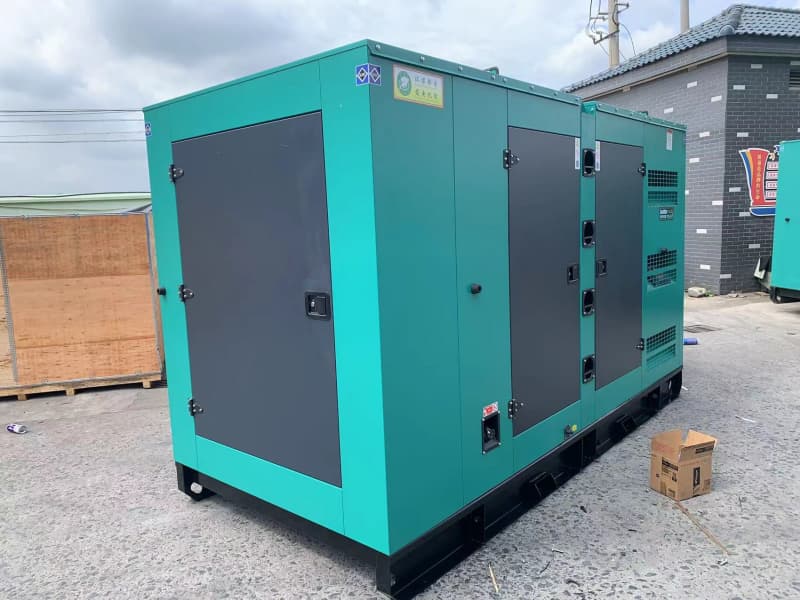
# Silent vs Open Type Diesel Generator: Which One Should You Choose?
When you're buying a diesel generator set, one of the first decisions you'll face is: silent canopy or open skid-mounted?
This choice affects everything from the price you pay to where you can install the unit, how loud it is, and how easy it is to maintain. At our Yangzhou factory, we build both types every day — and we test every unit on a 2 MW digital load bank before shipment. In this guide, we'll break down the real differences so you can pick the right one for your application.
What Is the Difference?
Open type generators are just the engine, alternator, and baseframe — no enclosure. You see the whole machine, and you hear the whole machine.
Silent type generators have the same core components, but they're wrapped in a heavy steel canopy lined with acoustic insulation. The canopy reduces noise dramatically and protects the unit from rain, dust, and snow.
Think of it like this: open type is the engine in your car without the hood. Silent type is the same engine, but fully enclosed in the car body.
Noise Level: The Biggest Difference
This is the number one reason people choose silent type.
| Type | Noise at 7 meters | Typical Application |
|---|---|---|
| Open type | 95–110 dB(A) | Construction sites, remote areas |
| Silent type | 65–75 dB(A) | Hospitals, offices, residential areas |
To put that in perspective:
- 100 dB(A) is like standing next to a chainsaw
- 70 dB(A) is like a normal vacuum cleaner
If your generator is running near people — in a hospital, a hotel, an office building, or a residential neighborhood — you must go silent. An open unit at 100 dB(A) would be unbearable.
If your generator is in a remote factory, a construction site, or a mine where workers already wear hearing protection, open type is fine.
Cost: How Much More Does Silent Cost?
Silent canopy adds roughly 15–25% to the total price of the generator set.
For example:
- A 200kW open type unit might cost $15,000–$20,000
- The same 200kW in a silent canopy might cost $18,000–$25,000
Why the premium? The canopy itself is heavy steel (often 500–1000 kg more weight), lined with special acoustic foam, and built with access doors and vents that don't leak noise.
When open type makes financial sense:
- You're on a tight budget
- The generator is in a soundproof room or container already
- It's a temporary unit for a construction project
When silent is worth the extra cost:
- You need to install outdoors near people
- Local noise regulations require it
- You want the unit to last longer (the canopy protects it from weather)
Installation and Footprint
Open type:
- Smaller footprint — just the baseframe size
- Can sit on a simple concrete pad
- No ventilation requirements beyond ambient air
- Easy to move around with a forklift or crane
Silent type:
- Larger footprint — the canopy adds 30–50% to the width and depth
- Needs clearance around the unit for air intake and exhaust
- Heavier — needs a stronger foundation
- Must be leveled carefully (the canopy doors must open and close properly)
If you're tight on space, open type is easier to fit. If you're installing outdoors and don't have a separate generator room, silent type is the way to go.
Maintenance Access
This is where open type wins.
With an open generator, everything is right there:
- Oil filter is easy to reach
- Air filter pops off in seconds
- Coolant drain is right at the bottom
- Battery terminals are exposed
With a silent generator, you have to:
- Unlatch and open the canopy doors (usually 2–4 doors)
- Work inside the enclosed space (it can get hot)
- Close and re-latch all the doors after service
Rule of thumb: if your maintenance team is experienced and does regular service, silent type is fine. If you're in a remote location with limited support, open type makes emergency repairs much faster.
Weather Protection
Open type: needs its own shelter. If you install it outdoors, you need to build a roof and walls around it — which costs money and time. And even then, rain and dust can get in from the sides.
Silent type: the canopy IS the shelter. It's IP44 or IP54 rated, meaning rain, snow, and dust can't get in. You just unload it on a concrete pad, connect the fuel and power cables, and it's ready to run.
For outdoor installations, the silent canopy often saves you money in the long run because you don't need to build a separate generator house.
Lifespan and Reliability
Here's a surprise: silent type generators often last longer than open type units.
Why? Because the canopy protects the engine and alternator from:
- Rain and moisture (which cause corrosion)
- Dust and dirt (which clog air filters and wear out seals)
- Direct sunlight (which degrades rubber hoses and belts)
An open generator sitting outside in the elements will show its age much faster than the same unit inside a silent canopy.
At our Yangzhou factory, we've seen silent units running for 10+ years with minimal corrosion, while open units in the same environment need repainting and seal replacement after 5–7 years.
Fuel Consumption
Does the canopy affect fuel efficiency? Slightly, but not much.
The canopy restricts airflow a little, so the engine has to work harder to pull in cooling air. This can increase fuel consumption by 2–5% compared to the open version.
But this is a tiny difference compared to the noise and weather protection you get. And if you size the cooling system correctly (we always do — every unit gets a full load bank test), the difference is negligible.
Parallel Operation and Control
Both types support automatic mains failure (AMF) start, remote monitoring, and parallel operation. The canopy doesn't affect the electrical system at all.
You can install a deep sea controller, a remote monitoring module, and paralleling switchgear on both open and silent units. The only difference is that on a silent unit, the controller panel is usually mounted on the outside of the canopy for easy access.
Which One Should You Choose?
Here's a quick decision guide:
Choose OPEN type if:
- ✅ Budget is tight
- ✅ The generator is in a soundproof room or container
- ✅ It's a temporary unit for construction
- ✅ You need easy access for frequent maintenance
- ✅ It's in a remote area where noise doesn't matter
Choose SILENT type if:
- ✅ It's installed outdoors near people
- ✅ Local noise regulations require it
- ✅ You want weather protection for longer lifespan
- ✅ It's for a hospital, hotel, office, or residential area
- ✅ You don't want to build a separate generator house
Our Recommendation
At Kaichen Power, we build both open and silent type generators ranging from 20 kVA to 3000 kVA. Every unit gets a 2 MW load bank test before shipment, and we offer a 1-year warranty with 24/7 technical support.
If you're still not sure, ask yourself one question: will people be within 50 meters of the running generator?
- Yes → silent type
- No → open type will save you money
Still deciding? Contact our team — we'll help you size the right generator and pick the right enclosure for your application.