
If you have ever sat through a clinic power cut with a patient on the chair, or spent a summer night moving refrigerated stock because the cold room lost power, you already know the feeling. The grid works until the one hour when it cannot.
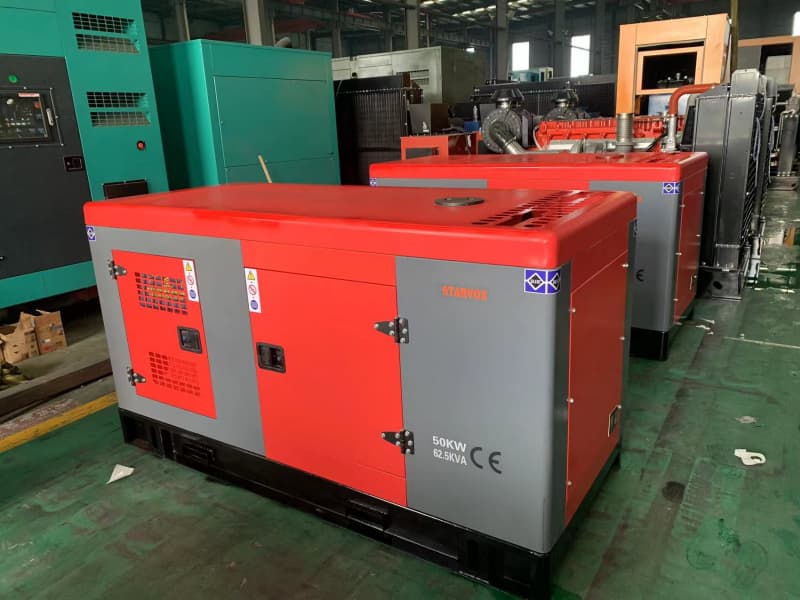
A 50 kW (about 62.5 kVA) silent generator is the size that solves that problem for a lot of small sites without turning into a capital project. But it is not automatic. Let us walk through what it actually fits, and where the trap is.
The clinics and farms that ask this question
The buyers who land on 50 kW rarely run a factory. They run:
- A rural clinic or dental practice with lighting, autoclave, fridge for vaccines
- A family farm with a milking parlor, irrigation pump and feed mill
- A self-storage facility with lighting and gate motors
- A small warehouse with racking fans and office cooling
- A village telecom tower hut backed by a local community
Across these sites, the running load is usually 30 to 40 kW. The motor loads — a 5 kW compressor, a 3 kW water pump — are what decide whether 50 kW is comfortable or cramped.
The vaccine fridge problem
There is a specific reason clinics care about sizing. Vaccine refrigerators are not like home fridges. They hold a steady temperature that must not drift, and they draw a high starting current. A generator that stutters on the first start will reset the fridge controller, and the temperature alarm goes off later, after the drugs may already be spoiled.
At 50 kW, a Mitsubishi-based silent set has enough surplus to start the fridge, the autoclave, and the office air-conditioner in sequence without a voltage dip. The automatic transfer switch handles the sequencing, so the staff do nothing except keep working.
Why the silent canopy matters on a farm
On a farm, the obvious answer is an open set: cheaper, weather-tough, easy to service. But open sets in this size run close to 95 dB(A) at one meter. Near a farmhouse, a worker cottage, or a school down the road, that noise becomes a complaint within months.
A silent canopy drops the sound to around 68–72 dB(A) at seven meters. The machine still lives outside, but you can install it 15 meters from the bedroom wall and sleep through the night. The canopy also keeps rain, dust and vermin out of the alternator, which on a farm matters more than in a tidy plant room.
The two mistakes small buyers make
Mistake one — undersizing for motor start. We see this often: a farmer adds the listed power of every machine, lands on 40 kW, buys a 40 kW set, and finds it trips when the milking pump starts. The starting current alone needs headroom that running numbers do not show.
Mistake two — overbuying for peace of mind. The opposite error is buying 100 kW for a 30 kW load. The engine runs cold, soot builds up, and fuel use per hour climbs. A lightly loaded diesel is not a happy diesel, and the bill at the pump tells you so.
The 50 kW band is where both errors stop hurting: it has enough headroom for motor starts, and it is not so large that the engine luggs at half load all its life.
A quick self-check
Before you ask for a quote, write down:
- Every device that must keep running during an outage.
- Which ones are motors (pumps, compressors, fridges) — they start hardest.
- Your voltage and phase (single phase 220V, or three phase 380V).
- Whether the set is standby (outages only) or prime (long hours of weak grid).
Send that list to us. If 50 kW is right, we will say so. If your motor list pushes you to 65 or 80 kW, we will tell you that too — saving you the cost of finding out on a bad night.