
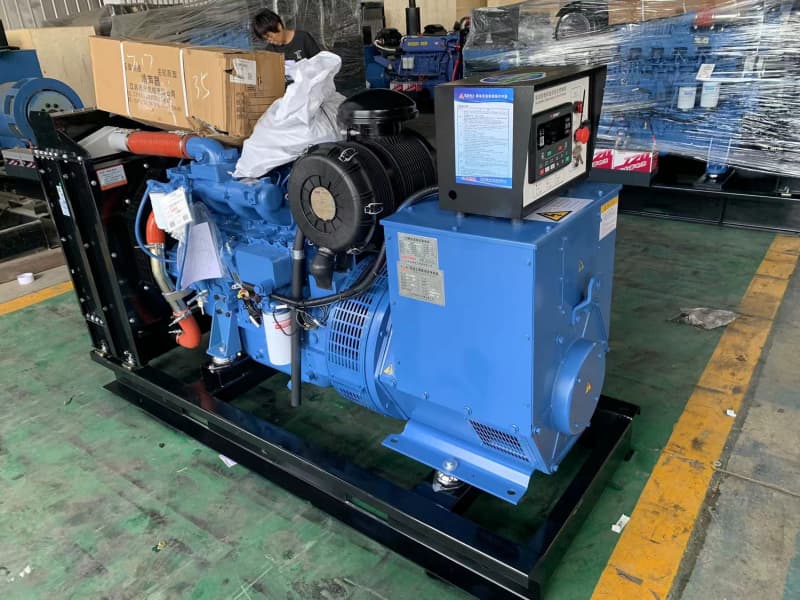
A diesel generator that won't start is every site manager's worst nightmare. Whether it's a hospital, a data center, or a remote construction site, a standby generator that fails to start when the grid goes down can mean lost production, spoiled inventory, or even life-safety issues.
At our Yangzhou factory, every generator set we ship goes through a 2-hour full-load test on our 2 MW digital load bank — we run it from 0% to 110% load, check voltage regulation to ±0.5%, and verify frequency holds at 50 Hz ± 0.25 Hz. But even the best-built set can refuse to start if it's not maintained correctly.
Based on thousands of service calls from our global network of authorized technicians, here are the 7 most common reasons a diesel generator won't start — with exact values you can measure yourself.
---
1. Dead or Weak Battery
This is the #1 cause of generator no-start — it accounts for roughly 40% of all service calls.
Diesel engines need a strong battery to crank the engine at a minimum of 150–200 RPM (revolutions per minute) fast enough to compress the intake air to about 35–45 bar, which raises the air temperature to around 550–600°C — the ignition threshold for diesel fuel.
What to measure:
| Battery Type | Fully Charged | Minimum to Start |
|---|---|---|
| 12V (single battery) | 12.6 – 12.8V | 12.2V |
| 24V (two batteries in series) | 25.2 – 25.6V | 24.4V |
What to check:
- Measure the battery voltage with a multimeter — not just the charger output.
- Inspect the battery terminals for white/blue corrosion (lead sulfate buildup). Clean with a wire brush and a baking soda solution (1 tablespoon baking soda in 1 cup water).
- Check the float charger (battery maintainer). It should put out 13.8–14.2V (12V system) or 27.6–28.4V (24V system). If it's unplugged or faulty, the battery will slowly self-discharge at about 1–2% per month.
The fix:
Most standby generators should be plugged into a permanent smart battery charger that maintains a float charge 24/7. If your battery is more than 3 years old, or if it can't hold 12.4V after a full charge, it's time to replace it — don't wait for a no-start in an emergency.
---
2. Fuel Supply Problems
Diesel fuel degrades. After 6–12 months in a tank, it starts to break down — oxidation forms gums and varnish, water condenses from temperature swings, and microbes (algae, bacteria) grow at the fuel-water interface.
What to check:
- Is the fuel shut-off valve open? It sounds obvious, but this is surprisingly common — especially after maintenance or a site visit.
- Fuel level: The tank should be at least 3/4 full. Running low means you're sucking air from the top of the tank.
- Fuel filter restriction: Most filters are rated for 10 micron or 2 micron filtration. If it's been more than 500 operating hours or 6 months, it's probably clogged.
- Water in fuel: Drain a small sample (about 100 mL) from the water separator into a clear glass bottle. If you see more than 5 mm of water at the bottom, or the fuel looks cloudy, you have contamination.
The fix:
- Add a fuel stabilizer (like Sta-Bil or equivalent) if the generator will sit idle for more than 1 month.
- Drain the water separator until clean fuel comes out.
- Replace the fuel filter if it's old or restricted. We recommend every 500 hours or 6 months, whichever comes first.
---
3. Low Coolant Level or Overheating Shutdown
Most modern generators have a low-coolant shutdown sensor that prevents the engine from starting (or shuts it down immediately) as a safety feature — designed to prevent catastrophic engine damage from overheating.
What to check:
- The coolant level in the overflow (expansion) tank. It should be between the "MIN" and "MAX" marks when the engine is cold.
- The coolant concentration. Use a refractometer to check the antifreeze mixture — it should be 50/50 (equal parts antifreeze and distilled water) for a freeze protection of about -37°C.
- Look for leaks: check the radiator hoses, water pump seal, and the cylinder block drain plugs.
The fix:
Top up the coolant with the correct premixed solution. Never add cold water to a hot engine — wait until it cools down to below 50°C, then add slowly. If you're losing coolant regularly, you have a leak — find and fix it, don't just keep topping up.
---
4. Air in the Fuel System (Vapor Lock)
Diesel engines are very sensitive to air in the fuel lines. Even a small bubble (1–2 mL) can stop the engine from starting.
This happens when:
- You run the generator completely out of fuel
- You replace the fuel filter
- There's a leak on the suction side of the fuel line
How to bleed the system:
- Locate the primer pump — usually a small lever or plunger on the fuel filter housing.
- Open the bleed screw on top of the fuel filter (1/2 turn).
- Pump the primer repeatedly (20–30 times) until clean fuel comes out of the bleed screw with no bubbles.
- Tighten the bleed screw while still pumping.
- Try starting the engine.
Pro tip: On larger engines (200 kW+), you may also need to bleed the injectors — loosen the injector leak-off lines and crank the engine until fuel comes out.
---
5. Emergency Stop Button Pressed
This is the easiest problem to diagnose — and the easiest to fix.
Almost every generator set has a red mushroom-shaped emergency stop button (E-stop). If someone accidentally bumps it, or if it was pressed during the last shutdown and not reset, the generator will not start — the control panel will show "E-STOP" or "EMERGENCY STOP" on the display.
How to reset:
- Twist the button clockwise (it should pop up).
- Press the "RESET" button on the control panel.
- Try starting again.
This is a 10-second fix, but it accounts for about 15% of no-start calls. Always check this first — before you check anything else.
---
6. Faulty Control Panel or Sensor Shutdown
Modern generators have sophisticated control panels (like Deep Sea Electronics DSE7320, ComAp InteliLite, or SmartGen) that monitor 20+ parameters in real-time.
If a sensor fails or goes out of range, the control panel will lock out the start circuit as a safety precaution.
Common fault codes and what they mean:
| Fault Code | Meaning | What to Do |
|---|---|---|
| LOW OIL PRESSURE | Oil pressure below 1.5–2.0 bar at idle | Check oil level, oil pressure sensor |
| HIGH COOLANT TEMP | Coolant above 95–100°C | Check coolant level, radiator fan, thermostat |
| LOW FUEL LEVEL | Fuel below 20% | Refill the tank |
| FAIL TO START | Engine didn't start within 10–15 seconds | Check battery, fuel, air in system |
| CHARGER FAIL | Battery charger not working | Check charger output, wiring |
The fix:
Write down the exact fault code or alarm message from the control panel display. Most modern panels have a USB port or Bluetooth that lets you download the fault history log — share this with your service technician. It saves hours of diagnosis time.
---
7. Starter Motor or Solenoid Failure
If you turn the key and hear nothing at all — no clicking, no cranking — the problem might be the starter motor itself or the solenoid that engages it.
What you hear:
- Click, click, click — the solenoid is working but the starter motor is drawing too much current (battery weak or starter worn).
- Nothing at all — check the fuses, the ignition wire, or the starter solenoid control circuit.
- Whirring sound but no engine cranking — the starter motor spins but the drive gear isn't engaging the flywheel (starter drive Bendix is worn).
Expected starter motor specs:
- Voltage: 12V or 24V (matches battery system)
- Cranking current: 200–400A for small engines (20–50 kW), 500–800A for large engines (200–500 kW)
- RPM output: 150–200 RPM at the engine flywheel
The fix:
Starter motors are expensive to replace (typically $300–$800 USD), but they're also one of the most reliable components on a diesel generator. Most starter motors last 10–15 years with proper maintenance. If it fails, it's usually because of worn brushes (carbon brushes) — on some models you can replace just the brushes instead of the whole motor.
---
Prevention is Better Than Cure: A Quick Maintenance Schedule
| Interval | Task |
|---|---|
| Weekly | Check battery voltage, fuel level, coolant level. Look for leaks or signs of pest infestation. |
| Monthly | Run the generator under at least 30% load for 30 minutes. This charges the battery, burns off moisture in the exhaust, and lubricates the engine. |
| Every 250 hours or 6 months | Change engine oil and oil filter. We recommend 15W-40 diesel engine oil (API CI-4 or higher). |
| Every 500 hours or 12 months | Replace fuel filter, air filter, and coolant filter. |
| Every 2 years | Flush the cooling system and replace the coolant. |
| Annually | Have a certified technician do a full inspection: load bank test, battery load test, fuel quality check, and exhaust leak inspection. |
---
If you're in the market for a new diesel generator set that's built to start reliably every time, take a look at our range of silent diesel generators — every set is tested on our 2 MW digital load bank before it leaves our Yangzhou factory, and we offer a 1-year or 1,000-hour warranty as standard. We also provide remote monitoring (GSM/SMS alarm) as an optional add-on, so you get a text message if the generator has a fault — even when you're not on site.
Have a question about your generator? Contact our technical team — we're available 24/7/365, and our engineers have an average of 10+ years of experience with Cummins, Perkins, Volvo, Weichai, and Yuchai engines.