
Most generator problems happen in the first ten minutes of running, and in cold weather those ten minutes decide everything. A set that starts reliably in a coastal city can refuse to turn over on a January morning at minus ten degrees. The buyers who have been through a northern winter know this. They spec differently.
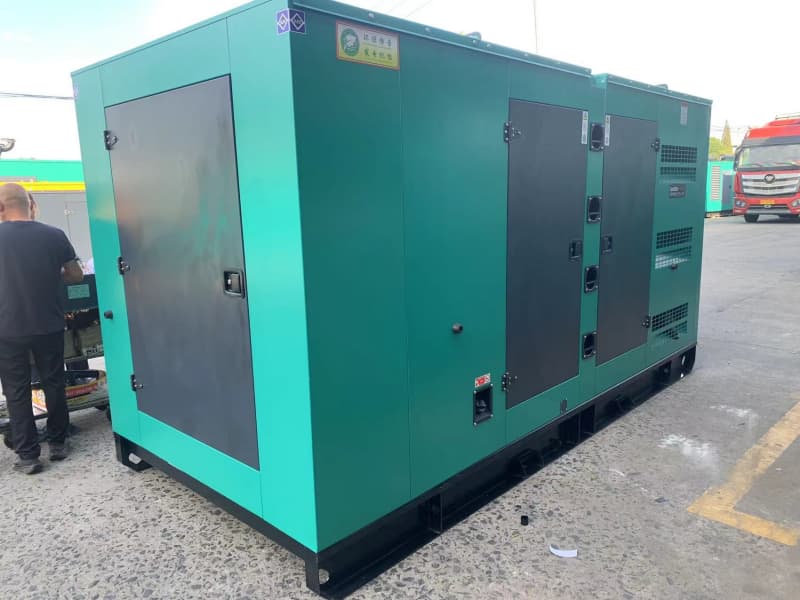
At 320 kW (around 400 kVA), a Volvo-based silent set is a common choice for cold-climate installations. The reason is not the badge. It is how the engine is built to behave when the thermometer drops.
What actually fails in winter
Walk into a service yard after a cold snap and you see the same stories:
- Batteries that will not hold charge. Cold halves the cranking power of a lead-acid battery. A battery that spins the engine at 20°C barely turns it at -10°C.
- Oil that is too thick. Multi-grade 15W-40 flows like honey in winter. The engine tries to start, the oil pressure builds slowly, and wear happens in the first seconds.
- Diesel that waxes. Below the cloud point, paraffin crystals form in the fuel and block the filter. The set starts, runs for a minute, and dies.
- Coolant that is too warm. An engine that idles at low load in winter never reaches operating temperature. Condensation builds up in the sump, and the oil turns into a milky soup.
- Canopy moisture. Heat meets cold metal inside the enclosure and condensation drips onto the alternator terminals.
A cold-climate package addresses all of these, not just one.
Why the Volvo block behaves differently
Volvo engines in the 300–400 kW range are used in construction and marine applications in northern Europe. That heritage shows in small details:
- The block is designed for fast warm-up, with water-jacket heating ports that accept a coolant heater.
- The fuel system tolerates a wider range of diesel grades without fault codes.
- The alternator is rated for a duty cycle that includes long idle periods in cold weather.
None of this matters in a mild coastal climate. It matters when the set has to start on demand at -15°C, carry the hospital load, and keep running until the grid returns.
The cold-climate kit we add
When a buyer tells us the site is in a cold region, we do not just sell the engine. The set leaves the factory with:
- An engine coolant heater, plugged into a small utility circuit, keeping the block warm 24/7 when not in use.
- A double battery setup with trickle chargers.
- Arctic-grade lubricating oil for the ambient range.
- A fuel tank heater and a water separator with a heater element.
- Canopy ventilation with a thermostat that closes in winter and opens in summer.
- Alternator space heaters to keep condensation off the windings.
That kit adds to the price. It also means the set starts when it has to.
Who should be thinking about this
- Sites in northern China, Central Asia, Eastern Europe, Canada, or mountain regions.
- Mission-critical loads (hospitals, telecom, data) where a failed winter start is not acceptable.
- Sets that sit idle for weeks and then must carry full load on a cold morning.
If your site never sees freezing weather, this package is optional and you can skip it. If it does, the cost of the package is small compared with the cost of a winter outage.
Ask before you order
Tell us the lowest temperature the site sees in a typical year, and whether the set is standby or prime. We will spec the cold-climate package to match — not more than you need, not less than you will regret.