
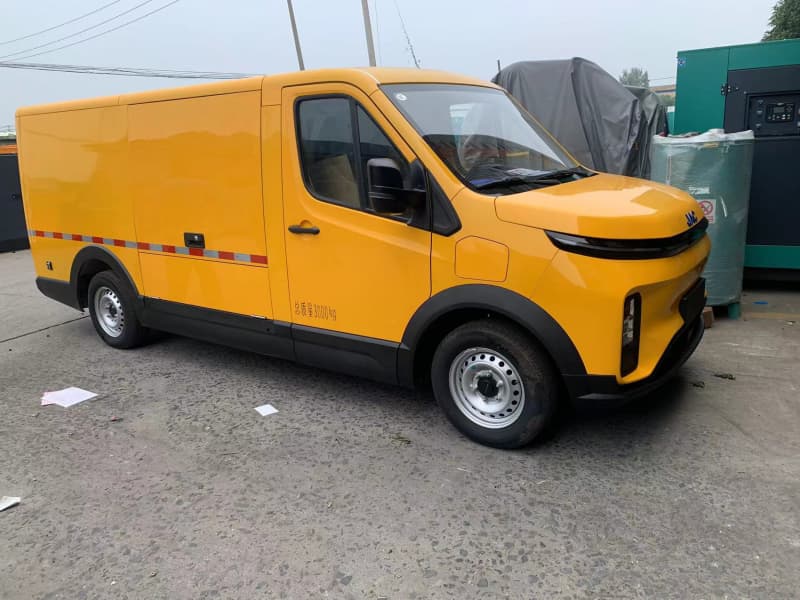
Most of this website talks about fixed sets: delivered to a building, bolted to a plinth, wired into the switchboard, and forgotten between outages. That is the right answer for a factory, a clinic, or an office.
But there is a whole other category of power user who does not have a building. They have a road, a field, a film set, a disaster zone, or a worksite that moves every week. For them, a fixed generator is the wrong shape. A mobile power car — a diesel generator mounted on a road-legal truck or trailer — is the answer.
What a power car actually is
A *power car* (also called a mobile power truck or mobile generator vehicle) is a complete power station on wheels:
- A diesel engine and alternator, usually 50 to 500 kW.
- A built-in fuel tank for 8 to 24 hours of running.
- An output distribution panel with sockets for cables.
- A cable reel compartment and on-board lighting.
- The whole assembly certified for road movement.
You drive it to where the power is needed, park it, plug in the cables, and you are running. When the job ends, you drive it to the next site.
Who actually uses mobile power cars
The buyers who rent or buy them are not building facilities. They are:
- Construction contractors who move from site to site and cannot afford to leave a generator behind.
- Event and film crews who need temporary power for lighting, cameras, and catering, then break down in a week.
- Disaster-relief teams who need power the day after a storm, when the grid is down for weeks.
- Mining and exploration crews who work in remote locations and pack up when the season ends.
- Utility repair teams who bypass a damaged substation while they fix it.
In every case, the value is mobility. A fixed set that costs less is worthless if it has to stay behind.
Fixed vs mobile: the honest comparison
| Question | Fixed set | Mobile power car |
|---|---|---|
| Will the load stay in one place for years? | Yes | No |
| Road legality needed? | No | Yes |
| Fuel storage planned on site? | Yes | Built-in |
| Cost per kW, new | Lower | Higher |
| Lifespan | Long, stationary | Shorter, vibration and road wear |
| Deployment time | Days (install, wire, test) | Hours (drive, park, plug in) |
The mobile version costs more per kilowatt because you are paying for the truck, the road certification, and the distribution panel. You are not paying for more engine. You are paying for the freedom to leave.
What to check before you buy or rent
A mobile power car looks simple, but it hides detail. Before you commit:
- Road certification. Can the truck legally be driven on public roads in your country? Weight, brake, and lighting rules vary.
- On-board fuel capacity. How many hours on one tank? A 100 kW set burns roughly 20 liters an hour.
- Output configuration. Are the sockets the right voltage and phase for your cables? Can it run three-phase equipment?
- Noise. A truck on a film set or a residential street must be quiet. A canopy-rated unit is non-negotiable.
- Self-protection. Does the cab have weather protection, fire extinguishers, and a lockable cable compartment?
- Service access. The engine still needs oil, filters, and coolant. Can a local workshop get to it, wherever it is parked?
The 100 kW power car sweet spot
A 100 kW (about 125 kVA) Yuchai-based power car is a common size. It carries enough power for a mid-size construction compound, a film location, or a relief camp. The truck is light enough to drive on normal roads without a special permit, and the fuel tank gives a full working day without refueling.
Smaller than 60 kW and the truck feels oversized for the output. Larger than 150 kW and the vehicle needs a heavy-duty chassis, special transport permits, and a driver with the right license. The 100 kW band is where the math works for most mobile users.
Tell us your moving load
If your power need moves — a jobsite, an event, a relief mission — tell us the load list and the road rules of your country. We will spec the power car that fits, and tell you honestly whether buying or renting makes more sense over the year ahead.