
You have probably just realised that your building or factory really needs backup power, and now you are staring at options. The brochures all look similar. The sales talk all sounds confident. And somewhere in the back of your mind is a worry: am I about to buy the wrong size?
You are right to worry. Sizing is where most generator buyers make an expensive mistake. Let's walk through how to think about it the way an experienced buyer would.
Step 1 — Don't size by nameplates, size by starting current
The first instinct is to add up everything that needs power: the offices, the servers, the air-con. That gives you a running load, and it is the wrong number.
The number that trips generators is starting current. When a motor, compressor or pump switches on, it pulls several times its running power for a moment. A generator sized on running load alone will stutter on that first start — lights flicker, computers reset. That is how "backup power" becomes the thing that fails you in the exact moment you needed it.
So when you talk to us, bring the list of motors and heavy equipment, not just the total.
Step 2 — Know your duty: standby or prime?
These are two very different questions:
- Standby — the set sits idle and runs only during outages. It rarely works, but it must always be ready.
- Prime — the set is your main power, running long hours because there is no grid.
A set bought for standby can be smaller and more affordable. A set bought for prime must be efficient and durable for long runs. Tell us which one you actually have, and the choice narrows fast.
Step 3 — Check the rules of thumb buyers learn
After a few projects, people settle on a few guides:
- Run the set at about 70–80% of rated power in normal use. Too small and it overheats; too big and it lugs underloaded and fouls up.
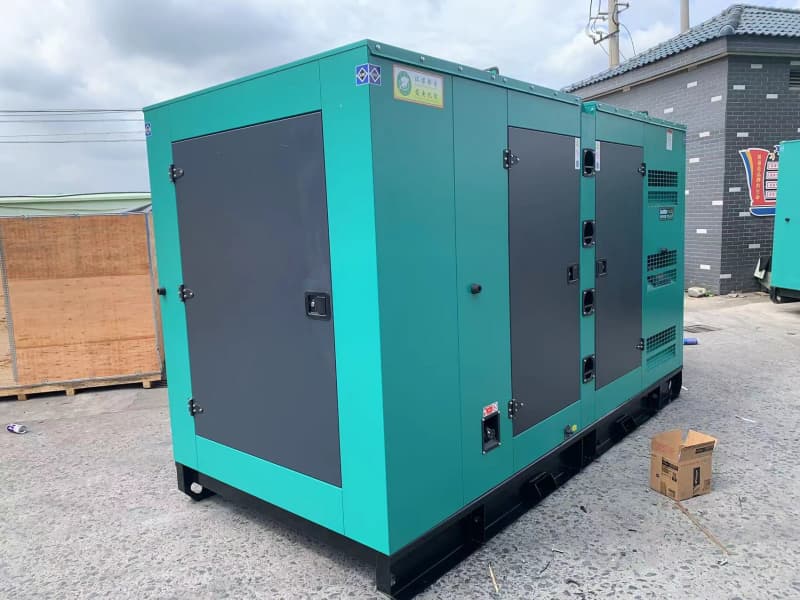
- If your real load is around 150–250 kVA, a 200 kW (250 kVA) silent set is the sweet spot.
- "Silent" means it can live outside near offices or homes — no separate machine room.
What you get at 200 kW
| Your question | The answer |
|---|---|
| What does 200 kW cover? | Mid-size offices, small production lines, clinics, server rooms |
| Will it run outside near people? | Yes — canopied, ~70–75 dB(A) at 7 m |
| How long on one tank? | ~8–10 hours at average load |
| Does it start by itself? | Yes — auto-starts on outage, switches back when mains returns |
The one mistake that costs the most
Buying a cheap engine that nobody locally can service. In a year, a part fails and the spare has to be shipped internationally. That is why so many experienced buyers land on a widely-supported engine like Cummins — not because of the badge, but because on a bad day someone can actually fix it nearby.
Tell us your real load
Send us what the generator has to power, your voltage, and whether it is standby or prime. We will tell you honestly whether 200 kW is the right size — and if it isn't, what is.