
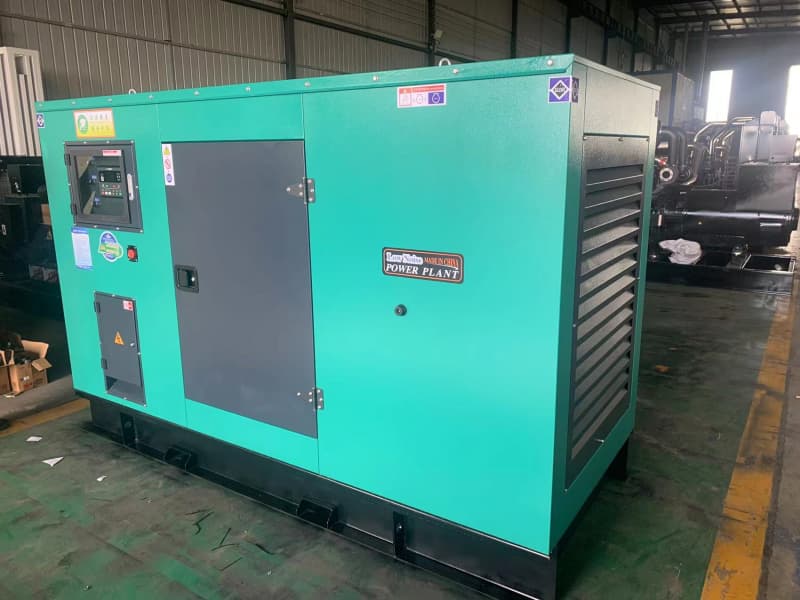
Walk around a mid-size city and you will see 200 kW and 300 kW sets everywhere: on the side of office blocks, behind shopping centers, on the back of plant buildings. They are workhorses. But once you walk into a data hall, a large hospital, or a broadcast center, the sets you find are a different class.
The jump to 500 kW is not a marketing tier. It is a real line between "the building should not go dark" and "the building must not go dark, ever, for any reason."
The loads that cross the line
A 300 kW set carries offices and production lines. At 500 kW, the typical load list looks different:
- A small data hall with racks and uninterruptible power supplies (UPS)
- A hospital wing with operating theaters, imaging, and intensive care
- A broadcast or telecom building with studio power and cooling
- A high-rise building with two elevators, fire pumps, and central chillers
- A water treatment plant with pumps and chemical dosing
These loads share a trait: they do not tolerate a slow start or a brief voltage dip. The UPS between the grid and the servers buys seconds, not minutes. The diesel set has to be up to rated voltage within seconds of an outage and carry the load smoothly.
Why the engine choice changes at 500 kW
At 100 or 200 kW, buyers ask about price and fuel use. At 500 kW, the question becomes transient response: can the engine accept a sudden load step without stalling?
Scania engines in this range are known for their response curve. The block is large relative to its rating, the turbo spools fast, and the governor picks up load quickly. That is the behavior that data halls and hospitals actually pay for — not a bragging number on the plate.
A 500 kW silent Scania set is not a louder, heavier version of a 100 kW unit. It is a different design brief: fast voltage recovery, stable frequency under step load, and a long warranty on the engine block.
The installation conversation changes too
At this size, the set is a project, not a delivery. Before you order:
- Fuel storage. A 500 kW set burns roughly 100 liters per hour at average load. A day tank is the minimum; a 24-hour basement tank is common for mission-critical sites.
- Paralleling. Many large sites install two 500 kW sets that share the load and run in parallel. If one fails, the other keeps the critical load up.
- Exhaust after-treatment. Tall stacks, flexible connections, and heat shielding become real engineering, not an afterthought.
- Vibration isolation. The set sits on spring isolators, and the building structure is checked for transmitted vibration.
- Maintenance access. At this size, you plan for crane removal of the alternator before the concrete is poured.
A rough rule for sizing mission-critical sites
| Critical load | Typical single-set choice |
|---|---|
| 250–320 kW | 400 kW set (with headroom) |
| 320–420 kW | 500 kW set |
| 420–550 kW | Two 300 kW parallel sets |
| Over 550 kW | Purpose-built power plant |
Notice the second row. The rule of thumb at this size is not to size the set to the load — it is to size the set so it never runs below 60%, even after one future expansion.
Talk to us early
If your load list is creeping past 300 kW and the building is the kind where a blackout is a serious problem, call us before you specify. We will look at the load steps, the fuel storage, and the room you have, and tell you honestly whether one 500 kW set or two smaller parallel units is the better shape.