
Walk into any mid-sized factory and you will find the same question on the maintenance manager's desk: the grid here is unreliable, production stops when it drops, and we need backup. But how big? Too small and the set trips on the first motor start. Too large and the budget is gone before you have bought the fuel tank.
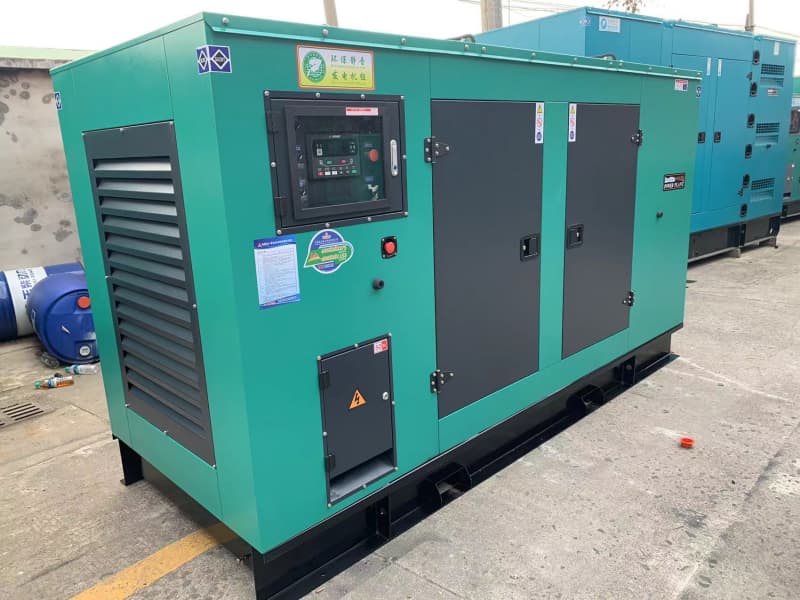
At 300 kW (roughly 375 kVA), a silent diesel set lands in a useful middle zone. It is the size that carries a real production line without becoming a building-sized installation. Let us be specific about what that means.
The load list a 300kW set is built for
Picture a manufacturing floor with a few CNC machines, a dust collector, a welding station, office lighting, and a compressor room. Add the air conditioning for the control office and the water pump for the workshop wash-down. The running load lands near 220 to 260 kW.
That is the sweet spot: the set runs at about 75% of rated power during normal operation, which is the duty cycle diesel engines actually prefer. Load it below 50% and the engine never reaches working temperature, blow-by builds up, and fuel economy worsens. Load it above 85% and it spends its life breathing hard.
Typical homes for a 300 kW set:
- A medium machining or metalworking workshop
- A furniture or packaging line
- A food-processing plant with chillers
- A mid-size commercial building with two elevators and central cooling
- A construction site office compound with tower crane and lighting
Why silent, at this size
Below 100 kW, an open set is often tolerated because it lives in a plant yard. At 300 kW the conversation changes. By this point the set usually sits near an office block, a reception area, or a neighboring property. An open set at this output is close to the hearing limit for all-day exposure.
A soundproof canopy brings the sound level down to around 70–75 dB(A) at seven meters. You can stand next to the building and hold a conversation. You can install it on the side facing a road without a noise complaint.
The trade-off is weight and footprint. A 300 kW silent set is a serious machine — expect around 2,500 to 3,000 kg and a container that needs a properly rated concrete plinth. Plan the access route before you order; a forklift door that is 10 cm too narrow has ended more than one installation.
The Doosan question: why buyers look at this engine
When buyers shop the 300 kW class, engine choice is where the conversation gets real. Doosan engines in this range are common because the block is simple, mechanical in its fuel system, and well supported across many markets. There are no exotic electronic controllers that only the dealer can touch. For a factory in a smaller city or an overseas plant, that serviceability matters more than a brochure horsepower number.
We do not argue that one engine brand fits every site. We argue that, at 300 kW, you should know what your local workshop can actually repair before you commit.
A rough sizing table
| Your real continuous load | Suggested set size |
|---|---|
| 180–240 kW | 250 kW set |
| 240–290 kW | 300 kW set |
| 290–350 kW | 350–400 kW set |
| Over 350 kW | Move to paralleled sets or a dedicated 500 kW unit |
These are starting points, not a purchase order. The motor-starting list, voltage, and ambient temperature move the real answer.
Tell us the floor plan
If you send us the load list and a rough layout, we will tell you whether 300 kW is the right step, and whether a silent canopy is enough or a containerized version suits the location better.